RTM in 2026: What Physical Therapy Practices Need to Know
Part 1 of the RTM Implementation Playbook Series
Your therapists are already texting patients between visits, answering questions about home exercises, and keeping them engaged in their care between appointments.
Remote Therapeutic Monitoring (RTM) is how you get paid for it—and how you improve outcomes while you’re at it.
But before you can build a program around it, you need to understand what’s actually changed with RTM this year, and why it matters beyond revenue growth.
To help practices get there, we brought together three of the most experienced voices in the space—Ben Barron, SVP of Sales at Limber Health, Rick Gawenda, Founder & President of Gawenda Seminars & Consulting, and Craig Brasington, VP of Revenue at Stride—for an honest conversation about:
- Why RTM matters clinically, not just financially;
- What’s changed with RTM codes and reimbursement in 2026; and
- What you need to know about compliance before you start billing.
This is Part 1 of a three-part series. In Part 2, we’ll cover the three decisions that determine whether your RTM program actually succeeds.
What is RTM, and Why Does it Matter?
Before we dig into the operational side of things, it’s important to understand the “why” behind RTM (spoiler alert: It’s not just financial).
First, for context, we’re still in the early adoption stages of RTM. In fact, Medicare only just introduced the reimbursable codes in 2022, and now they’ve expanded them further in 2026.
That matters because CMS doesn’t often add new CPT codes or change the revenue model for physical therapy. Barron put it frankly, “They’re not in the business of trying to make it easier for all of us to make a living.”
It means CMS sees the value of therapy. If they can expand that reach and allow more patients to receive care outside of the limited time they have during their in-clinic appointments each week, they know the positive outcomes will multiply.
At the same time, it’s an added revenue stream for your practice.
“Extending physical therapy care outside the four walls of your clinic—and outside of just the two or three in-person visits per week—is resulting in better clinical outcomes for patients,” Barron explained. “And therefore, it is an avenue through which you can be reimbursed for care.”
Better outcomes for patients, CMS, and your business—it’s a win-win-win.
What Practices Using RTM Are Seeing
“I wish my patients didn’t complete their home exercise programs,” said no therapist ever.
As Barron explained, “Every therapist that I've ever met, including myself, would tell you they would prefer if their patients did their home exercise program more often than they do.”
That’s exactly what RTM delivers. The numbers from practices using Limber Health’s platform show:
- 3.3x more home exercises completed
- 94% more likely to succeed with HEP
- 30%+ improvement in pain and function
- 2.1 more in-clinic visits per episode of care
The first three make a lot of sense. The more engagement outside the clinic leads to better outcomes. But that last stat is the one that tends to catch people off guard. If patients are getting more support outside the clinic, why are they showing up in person more often?
It comes down to engagement. When patients receive guidance between visits, they’re more engaged in their care, complete their home exercises, make therapy part of their daily routine, and show up for more appointments. And as a result, their clinical outcomes improve.
“This is not a billing exercise,” Barron concluded. “This is a change in the clinical care workflow model that enables better clinical outcomes for our patients. That also, by the way, you get paid for.”
And in 2026, there’s even more opportunity to get paid.
The State of RTM in 2026
Since RTM codes were first introduced in 2022, one of the biggest barriers has been the billing thresholds. They were high enough that shorter-term patients and lower-intensity monitoring often didn’t qualify. This year’s new codes change that.
Previously, practices were required to bill for 16+ days of data collection within a 30-day period (98977) and complete at least 20 minutes of treatment management time (98980).
The new codes allow for 2-15 days of patient data (98985) and 10-19 minutes of monitoring (98979)—opening the door for more of your patients to qualify.
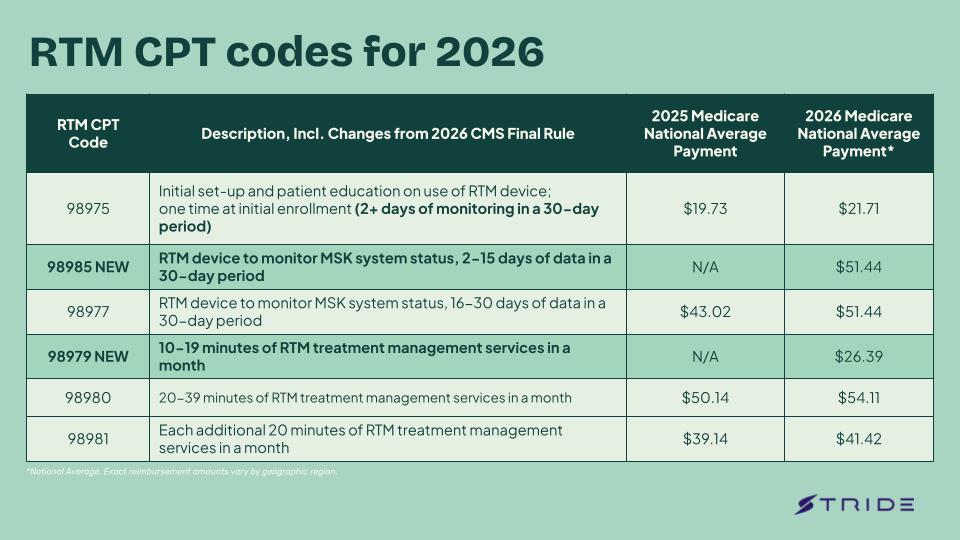
Interestingly, the payment amounts for 98985 and 98977 are the same at $51.44. Rick Gawenda explains that this is actually great rationale on the part of CMS. Because whether a patient transmits data for 2 days or 30 within that 30-day period, your practice is paying for an RTM app or medical device for the full 30 days.
With those new codes in mind, “I think you're going to see a lot more units being billed of RTM in 2026,” said Gawenda.
RTM Compliance Considerations
At this point, practices aren’t being audited solely for RTM records. But if you have to submit a chart for review of a patient who happens to be on RTM, everything is fair game in the audit. So, documentation to support your RTM billing is critical.
Starting with 98975, you want to ensure you document that you provided the monitoring device, educated the patient or caregiver on how to use it, and clearly outlined their exercise protocol—what to do, what data to track, and how often.
The next two codes, 98977 and 98985, are patient-dependent. So, on your end, you want to document whether you provided the medical device or SaMD, the frequency of data transmission, and the specific clinical data collected. If you’re audited, this proves that the patient actually transmitted data for the number of separate days you billed for.
The greatest compliance risk, though, would likely come from 98979, 98980, and 98981. These codes indicate that the therapist is logging in, reviewing transmitted data, updating the patient’s RTM program, and communicating with the patient to answer questions and provide ongoing guidance.
“That needs to be documented,” said Gawenda. “ In my opinion, you should be logging in at least three times a week.”
And remember, if you bill one of these codes, you have to have one interactive communication—phone call, two-way audio, FaceTime, etc.—with that patient in that calendar month.
“When RTM gets audited probably more often in the future, to me, this is going to be the big one,” Gawenda concluded.
The documentation habits you build now are what will protect you later. Get those right, and you can focus on what comes next… actually running the program.
How to Make RTM Work at Your Practice
RTM in 2026 has even more opportunity than it did when CMS rolled out the first set of reimbursable codes in 2022. Now, it’s proven that patients are more engaged, outcomes are better, and the new codes make it easier than ever to qualify more of your caseload.
And the improved outcomes don’t stop at the patient level. They become leverage for your practice.
“RTM is not a silo,” Gawenda explained. “Your patients on RTM are seeing 30% or greater improvement in pain and functional outcome. How can you then use that outcome data to help you renegotiate low-paying insurance contracts?”
RTM then becomes part of a hybrid of care that leads to better reimbursement across the board. But understanding why RTM matters and what’s changed in 2026 is only half the equation.
The other half is execution, and that comes down to three decisions:
- The staffing model you choose,
- The technology you build it on, and
- How you get your team to actually buy in.
We’ll cover that in Part 2 of the series, coming soon.